Our paper on MSC: Multi-Stage Caster-aware Control Framework with Uncertainty-Aware NMPC and RL-based Execution Layer was accepted to IEEE/RSJ International Conference on Intelligent Robots and Systems (IROS) 2026.
ROBOTICS · CONTROL · LEARNING
Jeonghyeok Lim
M.S. Student in Mechanical Engineering at KAIST
I am an M.S. student at KAIST, working in the Mechatronics, Systems and Control (MSC) Lab under the supervision of Prof. Kyung-Soo Kim. I received my B.S. in Mechanical Engineering from Korea University. My research interests include learning-based robot control, humanoid motion, and autonomous systems.

ABOUT
Research Profile
My research focuses on learning-based control and state estimation for humanoid robots and industrial mobile robots. I am particularly interested in reusable motion representations for diverse humanoid behaviors and robust control under uncertain contact dynamics.
More broadly, I aim to develop reinforcement-learning frameworks that allow robots to reason about their body dynamics and interactions with complex environments, enabling more adaptive and versatile behaviors.
If you have any questions or would like to discuss research ideas, feel free to reach out via email.
- Current affiliation
- KAIST · MSC Lab · Prof. Kyung-Soo Kim
- Education
-
M.S. in Mechanical Engineering, KAIST
Exchange Student, RWTH Aachen University Aug. 2024 – Mar. 2025
B.S. in Mechanical Engineering, Korea University - Research areas
- Humanoid robotics, learning-based control, AMRs, and autonomous systems
News
Publication
Journal Articles
No journal articles listed yet.
Conference Papers
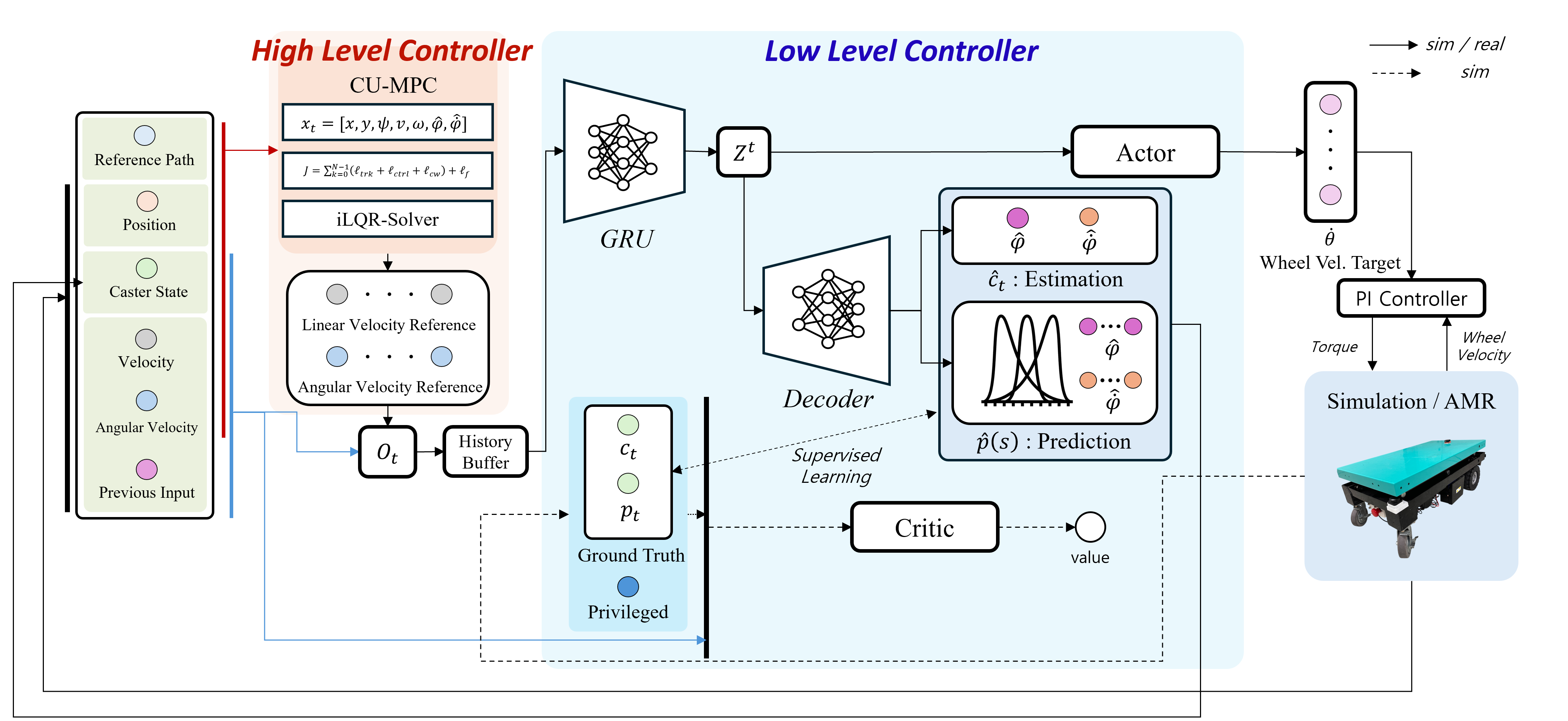
MSC: Multi-Stage Caster-aware Control Framework with Uncertainty-Aware NMPC and RL-based Execution Layer
IEEE/RSJ International Conference on Intelligent Robots and Systems (IROS), 2026
[Abs]
Freely swiveling casters are widely adopted in industrial AMRs/SDVs for their mechanical simplicity and load capacity. However, caster misalignment during low-speed or high-curvature maneuvers induces strong contact nonlinearities, widening the planning-execution gap between commanded (v, ω) and realized motion. Existing caster-aware strategies are highly sensitive to state-estimation reliability, causing unstable execution in uncertain transition regimes. To address this, we present Multi-Stage Caster-aware Control (MSC), a planning-execution integrated hierarchical framework featuring two core mechanisms. First, an uncertainty-aware NMPC (CU-MPC) dynamically schedules caster-aware costs and input regularization using predictive uncertainty to suppress overly aggressive maneuvers. Second, a reinforcement learning-based execution layer estimates and predicts caster states under partial observability, transforming high-level velocity commands into physically executable wheel speeds adapted to current contact conditions. Validations in Isaac Sim and real robots demonstrate that MSC offers a clear comparative advantage over existing decoupled compensation approaches by significantly improving caster-state estimation accuracy, minimizing misalignment, and enhancing tracking robustness in caster-sensitive maneuvers.
Preprints
ADP: Adversarial Dynamics Priors for Physically Grounded Humanoid Locomotion
ICRA — Under Review
arXiv preprint arXiv:2607.03454
[Abs]
In this paper, we propose Adversarial Dynamics Priors (ADP) for perturbation-resilient humanoid locomotion control. Existing motion prior-based methods induce natural motion styles by imitating kinematic motion features, but they do not directly regularize dynamics features, such as CoM motion, centroidal momentum, contact forces, and contact states. To address this limitation, we replace kinematic motion-style features with selected dynamics features extracted from locomotion trajectories as the target of adversarial regularization. To this end, we use trajectory optimization to construct a reference dataset and train a discriminator to evaluate whether policy-induced temporal windows are consistent with the resulting reference distribution. Without explicit motion tracking, ADP encourages policy rollouts to remain close to the reference support, even after perturbations. Experimental results show that, compared with AMP, the strongest baseline in our evaluation, ADP improves the 80%-success impulse threshold (J80) by 16.7%, while reducing direction-averaged recovery time and velocity tracking error by 47.9% and 35.4%, respectively.